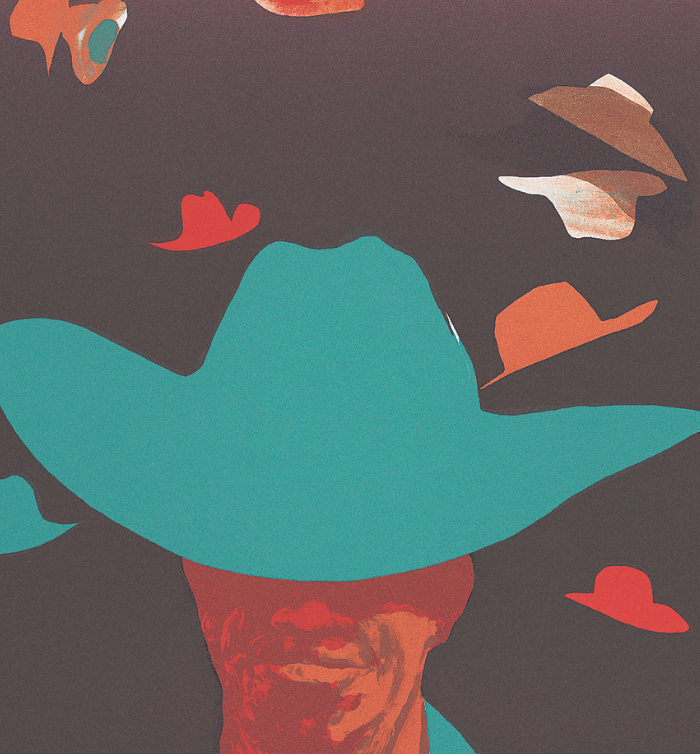
1999 Ted Rose "Big Hats No Cattle"
"Big Hats no Cattle" Poster 22" x 28" | Signed Lithographs
Ted Rose (1940–2002) specialized in watercolors, in particular, watercolors centering around 20th-century American railroad art. (In 1999, the U.S. Postal Service selected him to paint five locomotives for the “All Aboard” stamp series, and Amtrak picked him as the artist for its 1997, 1998, and 1999 calendars.)
Although he painted plenty in his younger years and majored in art in college, financial necessity more or less forced him to give up painting until 1983. That year, he started painting again, and from then on produced over 1,000 works over the next 20 years, most of which centered on realistic depictions of trains and the railroad.

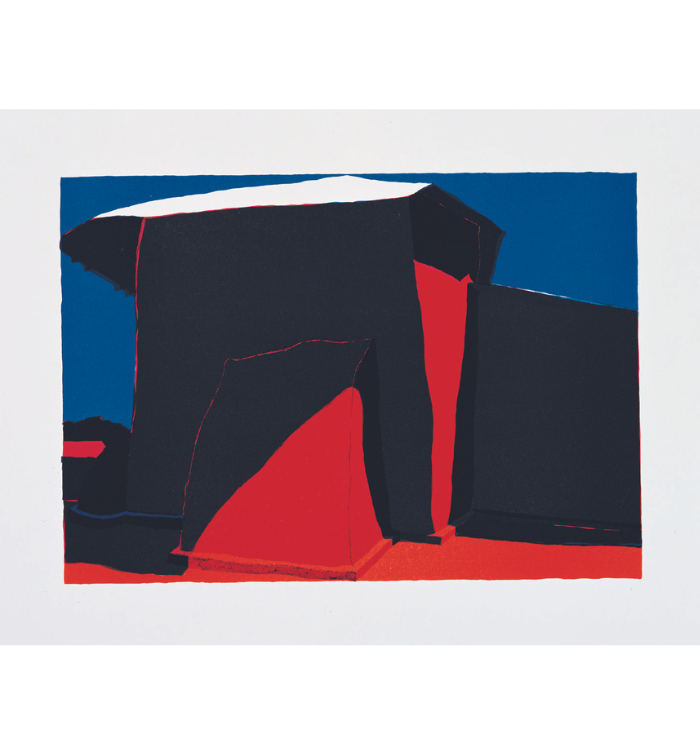
1996 H. Joe Waldrum "September 26-29, 1996"
"September 26-29, 1996" Poster 22" x 28"
Harold Joe Waldrum (1934–2003) was an American artist best known for his vivid abstract studies of Northern New Mexico’s historic adobe churches. Initially using a Polaroid SX-70 as a tool for planning his paintings, he eventually produced thousands of photographs that became an acclaimed body of work on their own, shown in multiple museums and galleries.
Before becoming a full-time artist, Waldrum taught music and art in Kansas for more than 15 years after graduating from Western State College. He completed a graduate degree in 1970 and soon relocated to New Mexico, which became the center of his artistic focus.
Later in his career, Waldrum worked to protect the very churches that inspired him. In 1985, he founded an organization dedicated to their preservation and created documentaries highlighting their decline and destruction. During the 1980s and 1990s, he also collaborated with printmakers to produce aquatint etchings and linocuts that echoed the style of his paintings.
Waldrum passed away in 2003 and is buried in Columbus, New Mexico. His work is included in the collections of several institutions, including the Museum of New Mexico, the Palm Springs Art Museum, the Albuquerque Museum, and the Harwood Foundation of Taos.
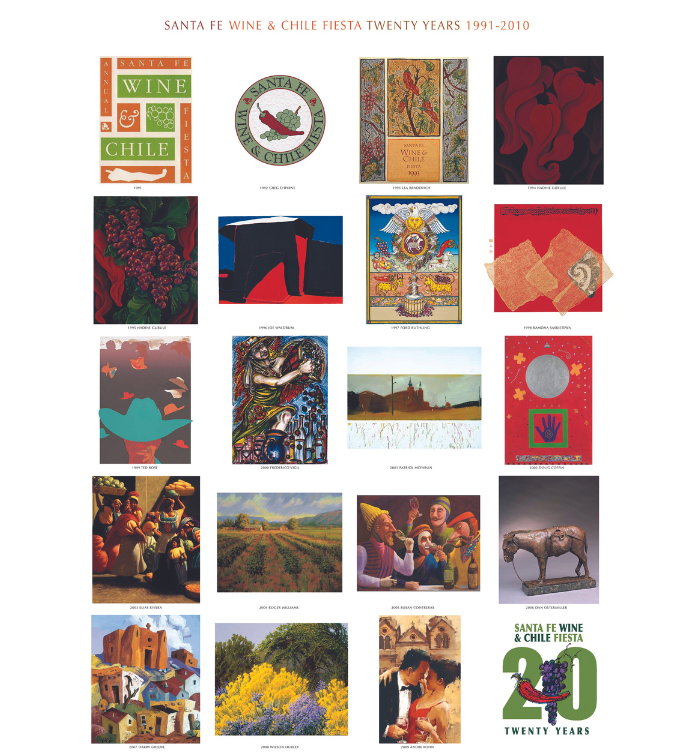
2010 Santa Fe Wine & Chile Fiesta Twenty Years "20th Anniversary"
"20th Anniversary" Poster 24" x 36"
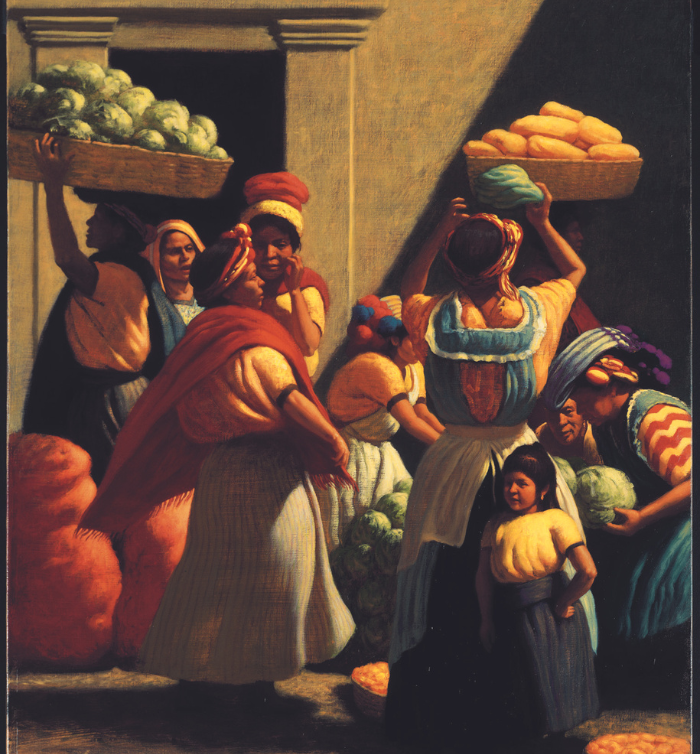
2003 Elias Rivera "SFWCF 2003"
"SFWCF 2003" Poster 22" x 30"
Rivera was born in 1937 in New York City and in 1982, moved to Santa Fe, where he soon established himself as an internationally acclaimed painter. He attended the Art Students League (under the tutelage of Frank Mason), and painted somewhat disturbing canvases of New York’s raw street life.
In his paintings, Rivera explores the colorful costumes and street life of the native populations of Santa Fe, New Mexico; Guatemala, Mexico and Peru.
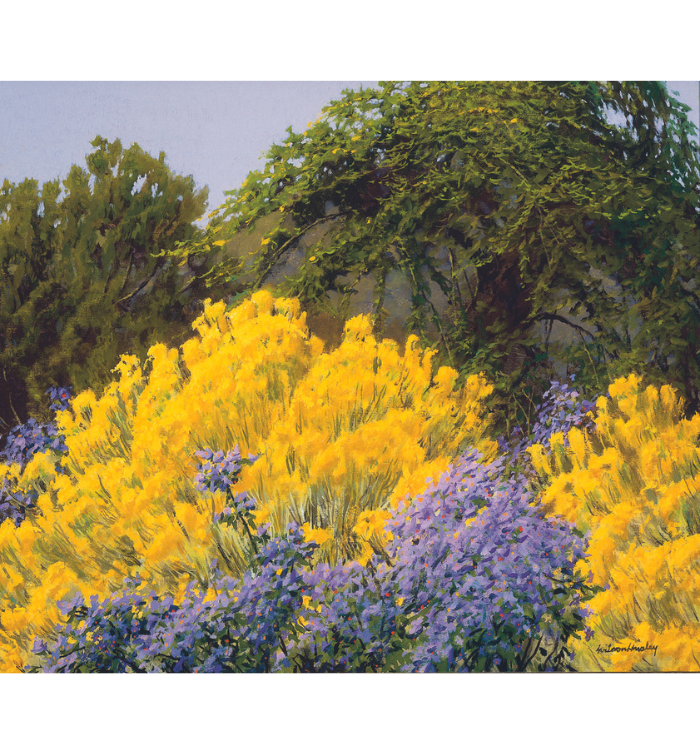
2008 Wilson Hurley "October in Santa Fe"
"October in Santa Fe" Poster 29" x 25"
Wilson Hurley (1924 - 2008) was born in Tulsa and spent his early years in Virginia and New Mexico. The beauty of New Mexico and its art traditions led to his early interest in painting. Trained as a pilot at West Point and an early tour of duty in the Philippines encouraged the broad perspective that enriches his work. His extensive studies of history, art history and the sciences give his work a sense of reality that he has edited in the best tradition of representational art. His work illustrates his wide-ranging interest in landscape, outer space, aerospace, as well as portraiture and still life and is an attempt to present a complete accounting of his work.
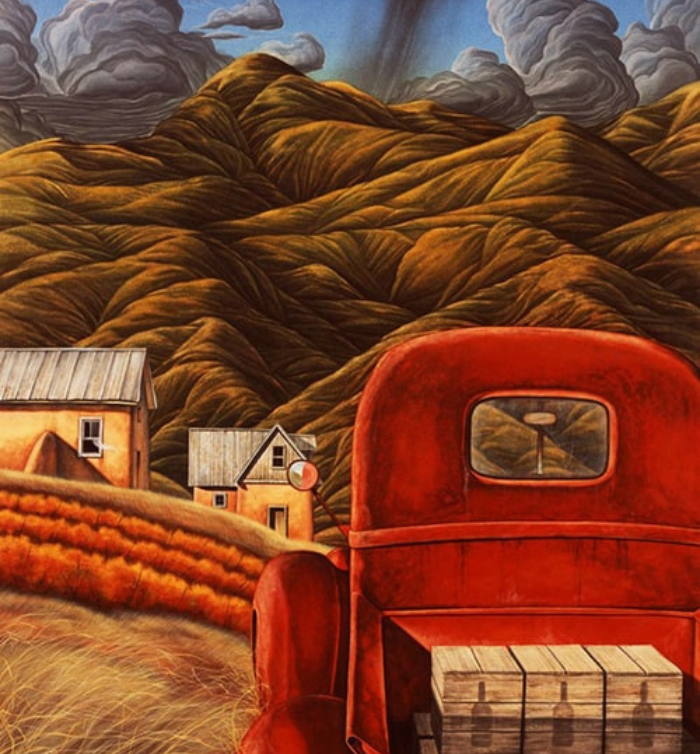
2013 William Haskell "Bound for Santa Fe"
"Bound for Santa Fe" Poster 18" x 24"
Haskell, 44, lives in Galisteo, just south of Santa Fe, and often paints scenes of the surrounding landscape. Other favorite locations are north of Las Vegas, along the High Road to Taos, and in the small village of Rancho de Las Golondrinas. In his watercolors, real-life images often shape-shift.
Haskell’s biggest influence was another realist painter: Andrew Wyeth
Haskell began drawing at the early age of four, and was introduced to watercolor by the age of eleven. “Drawing,” he once said, “is the basis for my painting and it has been essential for me to continuously develop my drafting skills.”
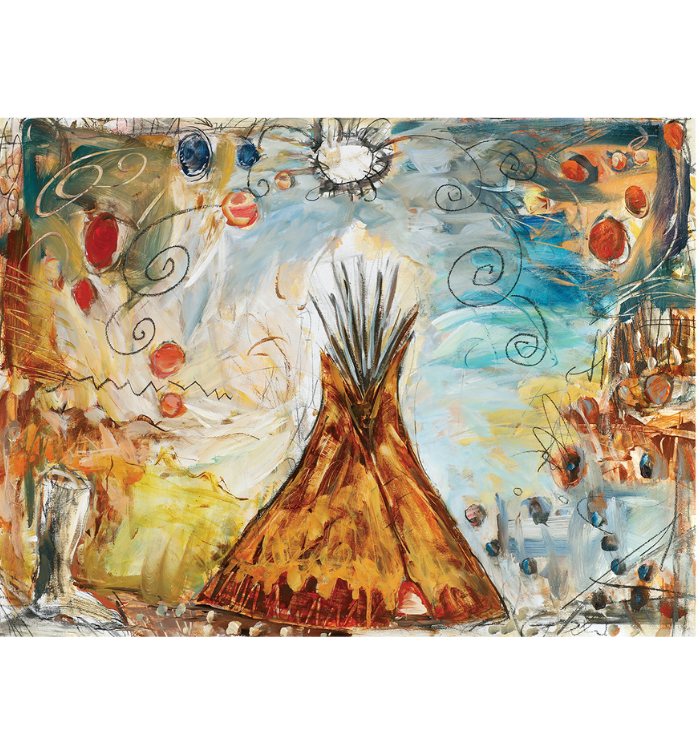
2016 Darren Vigil Gray "Earth Song"
"Earth Song" Poster 24" x 32"
Vigil Gray, of Jicarilla and Apache/Kiowa Apache heritage in northern New Mexico, has been called the “Golden Boy of the third generation” of Native American painters. He began studying art in 1975 while enrolled in the high school program at Santa Fe’s Institute of American Indian Arts. He later studied at the College of Santa Fe and the University of New Mexico, but by 1986 had given up academics and was painting full-time.
Inspired by several artists over the years (most notably the great Kiowa/Caddo painter T. C. Cannon, Vigil Gray’s first mentor), since 1990, Vigil Gray’s work has reflected his admiration for Abstract Expressionists such as Willem de Kooning and Jackson Pollock, as well as members of the Bay Area Figurative movement—Elmer Bischoff, David Park, and Richard Diebenkorn.
As he has said of his painting technique: “I have to make a lot of chaos, and out of the chaos I start massaging the forms into play. It’s almost predestined, but I have to go through this process of chaos and find resolution to it.”
The canvases he’s become best known for are his “mythological” paintings, or “dreamscapes”—ambitious compositions of haunting characters created entirely out of his imagination and often draw from the area near his homeland near Abiquiu, New Mexico.
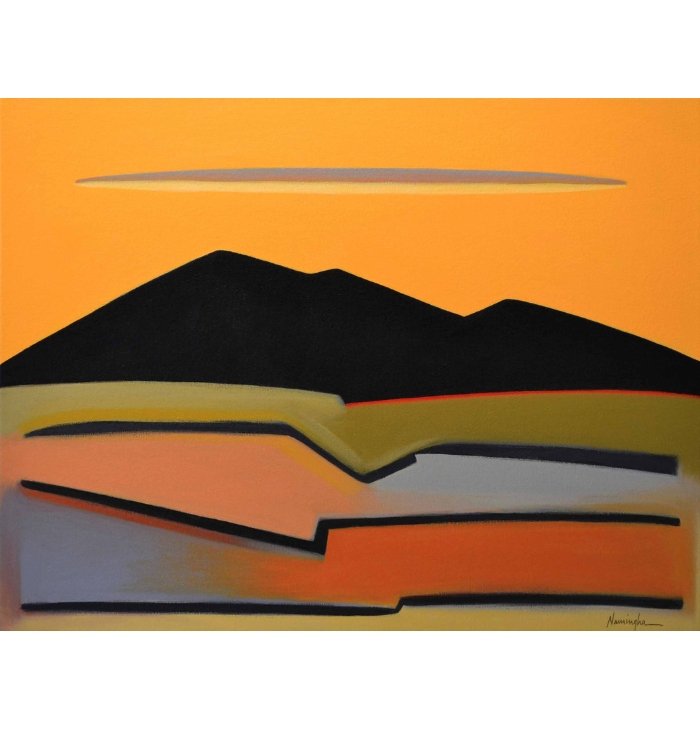
2015 Dan Namingha "Desert Light"
"Desert Light" Poster 24" x 32"
Namingha, born in Keams Canyon, Arizona in 1950, is a painter and sculptor, and great-great-grandson of Nampeyo, the hugely influential Hopi-Tewa potter who lived on the Hopi Reservation in Arizona.
A longtime Santa Fean, Namingha studied at the Institute of American Indian Arts in Sante Fe, and at the American Academy of Art in Chicago, where he was influenced by the work of Jackson Pollack, Adolph Gottlieb, Michelangelo, Vincent Van Gogh, and Norman Rockwell.
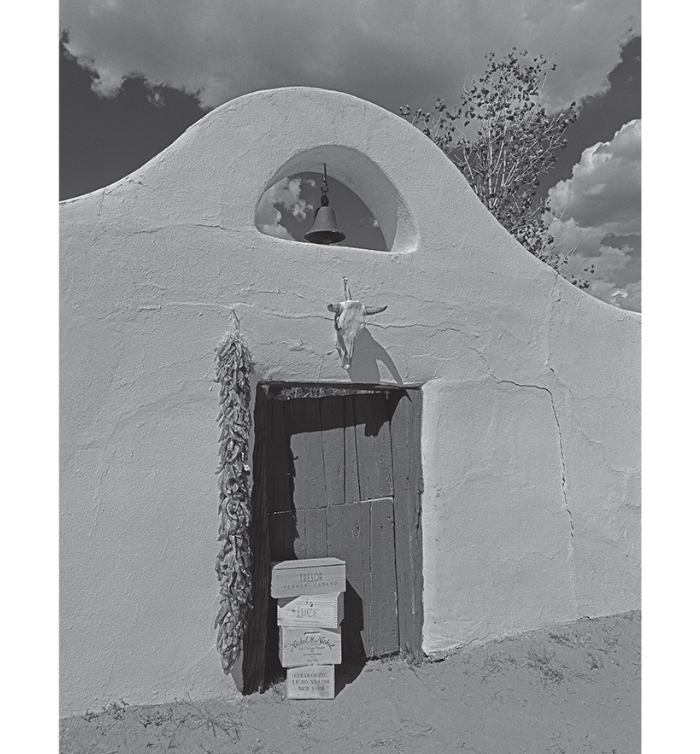
2014 Cody Brothers “Special Delivery on The Santa Fe Trail”
"Special Delivery on the Santa Fe Trail" Poster 24" x 32"
Cody is a New Mexican photographer and owner/operator of Visions Photo Lab in Santa Fe, NM.
Growing up in the Four Corners region, Cody’s most memorable childhood experiences were exploring the land. His photographic journey began as an adolescent when his grandfather gave him a Canon AE-1 after returning home to Farmington, NM from a voyage overseas.
His early artistic influences centered mostly around painters like Da Vinci, Dali, Delacroix, and Picasso, however, he was inspired at a very young age to embark on adventures to many of the iconic locations in the National Parks of the West because of the black and white photographs of Adams, Gilpin, Strand and Weston.
Cody has observed and documented the magnificent beauty of these places as well as the significant impact of man made change that has occurred over the decades.
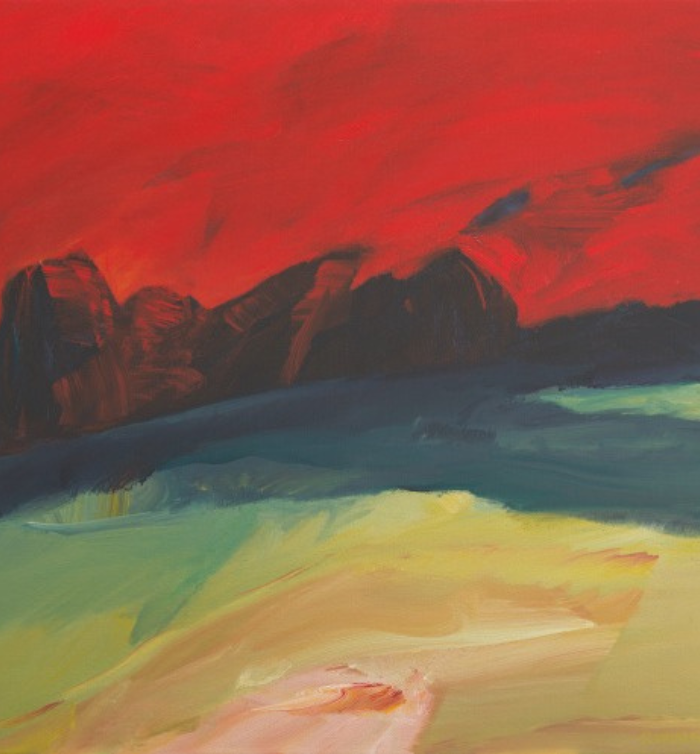
2017 Dick Evans "Dark Forms with Red Sky"
"Dark Forms with Red Sky" Poster 24" x 32"
Born in the Land of Enchantment, Evans grew up in a rural farming community in the panhandle of Texas, where he had no exposure at all to art until he started college. While in college, though, he was required to take drawing and design courses (as part of his curriculum as an architecture major). He soon realized architecture was not right for him but art was.
He then switched to an advertising art program at Texas Tech, where he then realized he was more interested in Fine Arts. So he then transferred again—to the art program at the University of Utah, where he obtained a BFA in Drawing and Painting and went on to obtain an MFA in Ceramics and Sculpture.
After college, he began a university teaching career, being granted tenure at just 29. Uneasy about settling into one area so early in life he resigned within the month and set out on his own with his wife and two children, establishing studios in Northern New Mexico in which he produced sculpture and ceramics.
After a year he realized how much he missed teaching and returned to the university scene. He spent a year teaching at the University of Tennessee-Knoxville. Then he spent three years teaching art at the University of New Mexico. In 1975 he married for the second time. This time to sculptor Susan Stamm Evans, with whom he is still married. Then in 1975 he took a position teaching art at the University of Wisconsin-Milwaukee. Evans progressed through the professorial ranks to tenure, full professorship and also a two-year stint as Associate Dean of the School of Fine Arts.
In 1987 the Evans’ decided to leave academia and devote themselves full-time to their art. In 1990 they returned to New Mexico, moving to Santa Fe, where they built a house with two studios.