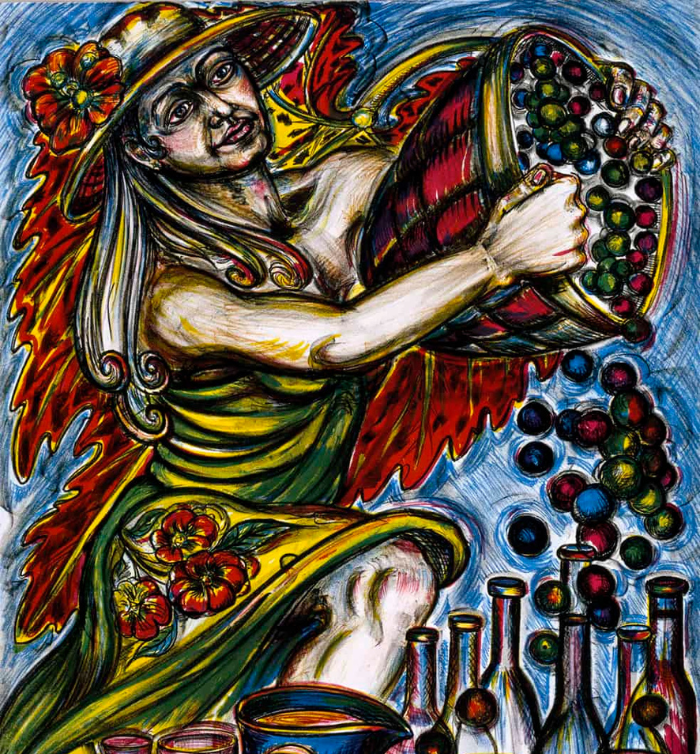
2000 Frederico Vigil Signed Lithograph
2000 Frederico Vigil Signed Lithograph
Born and raised in Santa Fe, along what used to be the barrio near Canyon Road, Vigil specializes in frescoes. He first discovered the art of fresco painting during an internship in 1984 with Lucienne Bloch and Stephen Pope Dimitroff (themselves apprentices to renowned muralist Diego Rivera).
Inspired by these and other fresco masters, Vigil has since completed more than two dozen major fresco pieces, including one of the largest concave frescos in the world (inside the Torreón at Albuquerque’s National Hispanic Cultural Center, a fresco that spans 4,000 square feet).
One of his most recent works is located at the University of Notre Dame.

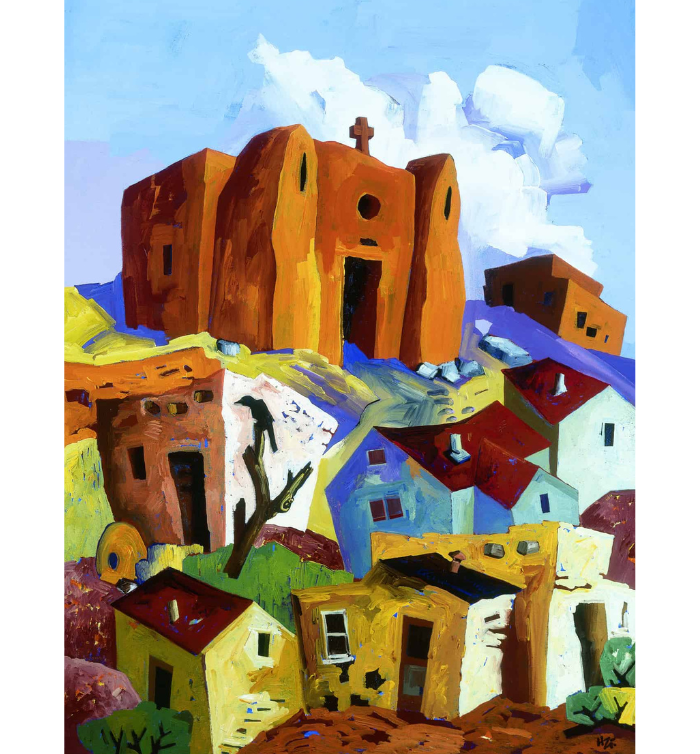
2007 Harry Greene Signed Lithograph Print
2007 Harry Greene Signed Lithograph Print
Harry Greene (1934–2024) was born in New Jersey and studied painting at Syracuse University. Early in his career, he exhibited widely in regional and juried shows, including the Butler Annual, the Pennsylvania Academy of the Fine Arts, and the Carnegie International. After relocating to Florida, he taught painting, exhibited in galleries across the state, and was selected for the Jacksonville Museum’s Best of Florida exhibition.
Travel in Europe, where he studied the works of Piero della Francesca, Giotto, and Masaccio, further shaped his artistic vision. In the early 1990s, Greene settled in New Mexico, where he found lasting inspiration. His expressive, richly colored paintings draw from the architecture, landscapes, and rural communities of the Southwest. Although based on direct observation, his works are imaginative composites of the elements he encountered.
Greene’s art was shown prominently at Manitou Gallery, where his creativity resonated with many. His career reflected a lifelong dedication to painting and the profound fulfillment he found in following his artistic path.
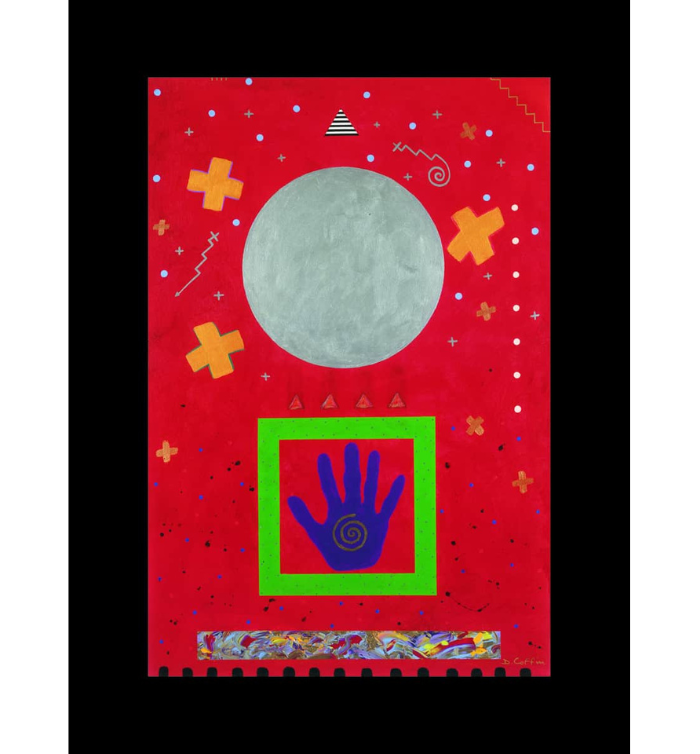
2002 Doug Coffin Signed Lithograph Print
2002 Doug Coffin Signed Lithograph Print
Coffin, a painter of contemporary art and a sculptor, often draws from his sense of “apartness” as a Potawatomi/Creek Indian. A feeling from his having spent his first 20 years living on the grounds of the Haskell Indian College boarding school in Lawrence, Kansas, where his father served as the school’s athletic director. (During the summers, Coffin would stay with his grandmother on the Potawatomi Reservation.)
Best known for his monumental, brightly painted steel and mixed media sculptures, Coffin has honed a style that merges the ancient totemic form used by many Native cultures with the abstraction and geometric forms of the modernist. He earned his BFA from the University of Kansas and later an MFA from the Cranbrook Academy of Art. His work has been exhibited widely throughout the world, including the Grand Palais in Paris and the John F. Kennedy Center in Washington, D.C.
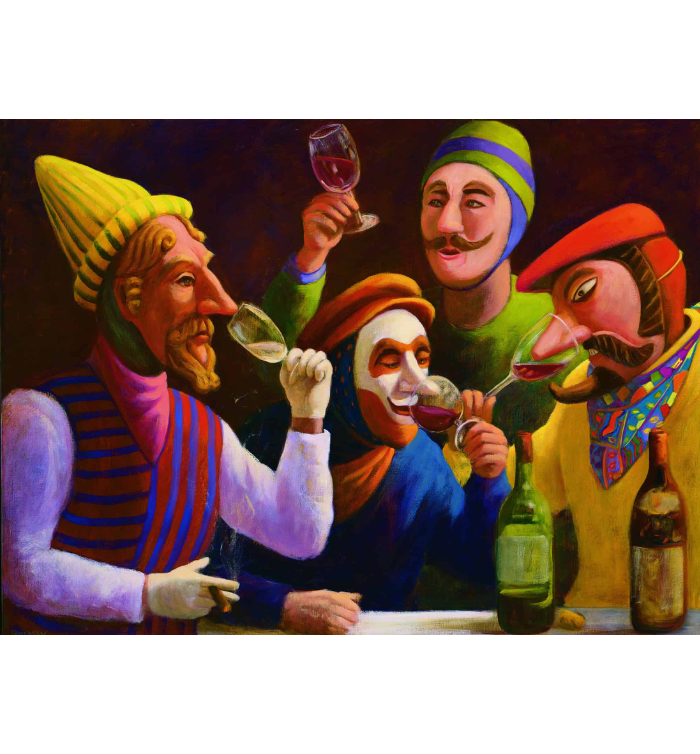
2005 Susan Contreras Signed Lithograph
2005 Susan Contreras Signed Lithograph
Born in Mexico City to a mother who was a portrait painter and a Mexican jeweler father, Susan Contreras moved with her family to Santa Barbara, California when she was age 5. The family traveled frequently to Mexico where she became fascinated by ceremonies involving masks, such as the Day of the Dead. It was the bringing together of drama and color, and that combination underlies her paintings.
In 1968, her family moved to Santa Fe, New Mexico so her sister could attend the School for the Deaf. Susan got interested in photography from a high school class. Then she studied at the Brooks Institute in Santa Barbara and completed a degree in photography, later receiving a BFA and MFA from the University of California at Santa Barbara. She also studied at Maine’s Skowheagan school of Painting and Sculpture. Her greatest academic influences, though, came Nathan Oliveira and Wayne Thibeaud at the Santa Fe Institute of Fine Arts while her early work as a photojournalist gave Contreras an interest in visual narrative that has informed her paintings from the beginning.

2012 Phyllis Kapp "Soft Summer Days"
"Soft Summer Days" Poster 24" x 18"
It was 25 years ago that Kapp opened her studio on Canyon Road in Santa Fe. The studio eventually evolved into Waxlander Gallery, where over time she nurtured and represented countless other artists.
Kapp, who was born in Chicago in 1930, has often said she is inspired by nature, specifically the landscapes of northern New Mexico. But she is quick to point out that her work stays fresh and is always changing in spite of her long-standing attraction to this rugged region as subject matter.
“Nature,” she once said, “doesn’t do things in the same way all the time. Why should I?”
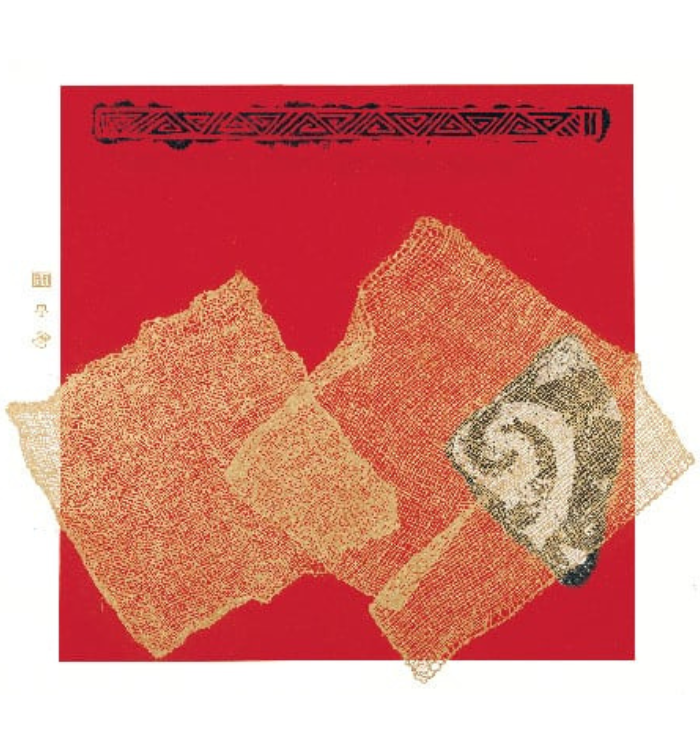
1998 Ramona Sakiestewa
1998 Ramona Sakiestewa Poster 22" x 28" | Signed Lithographs
Sakiestewa, born in 1948, is a contemporary Native American artist renowned for her tapestries, works-on-paper, and for her public art/architectural installations. In the late 1960s, she traveled to New York City to study at the School of Visual Arts, then returned to the Southwest, where she took a job as an arts administrator at Santa Fe’s Museum of New Mexico.
Largely self-taught as a weaver, Sakiestewa uses prehistoric Pueblo techniques from the American Southwest. In 1994 she was invited to join the architectural design team for the National Museum of the American Indian, Smithsonian Mall Museum, Washington, D.C. In 2009 she closed her Santa Fe weaving studio to further develop her works-on-paper and painting and architectural projects.
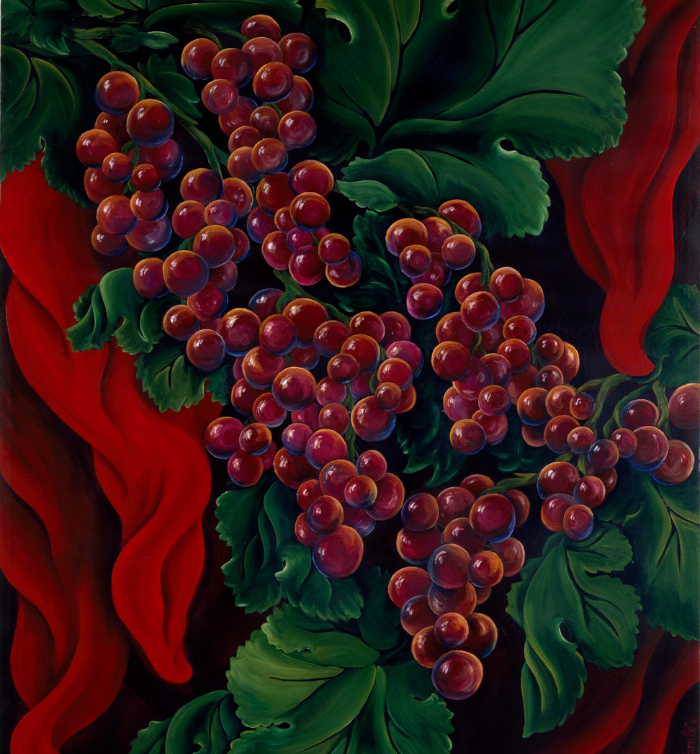
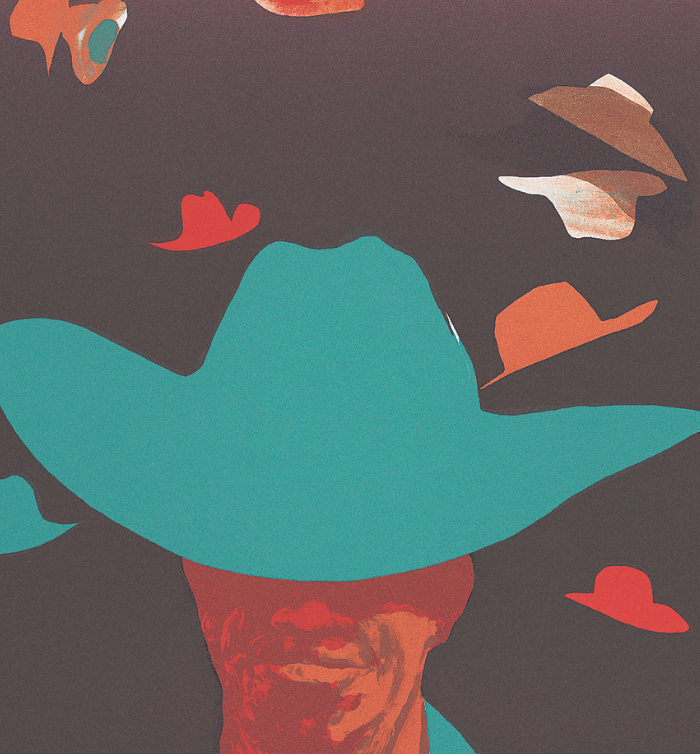
1999 Ted Rose "Big Hats No Cattle"
"Big Hats no Cattle" Poster 22" x 28" | Signed Lithographs
Ted Rose (1940–2002) specialized in watercolors, in particular, watercolors centering around 20th-century American railroad art. (In 1999, the U.S. Postal Service selected him to paint five locomotives for the “All Aboard” stamp series, and Amtrak picked him as the artist for its 1997, 1998, and 1999 calendars.)
Although he painted plenty in his younger years and majored in art in college, financial necessity more or less forced him to give up painting until 1983. That year, he started painting again, and from then on produced over 1,000 works over the next 20 years, most of which centered on realistic depictions of trains and the railroad.
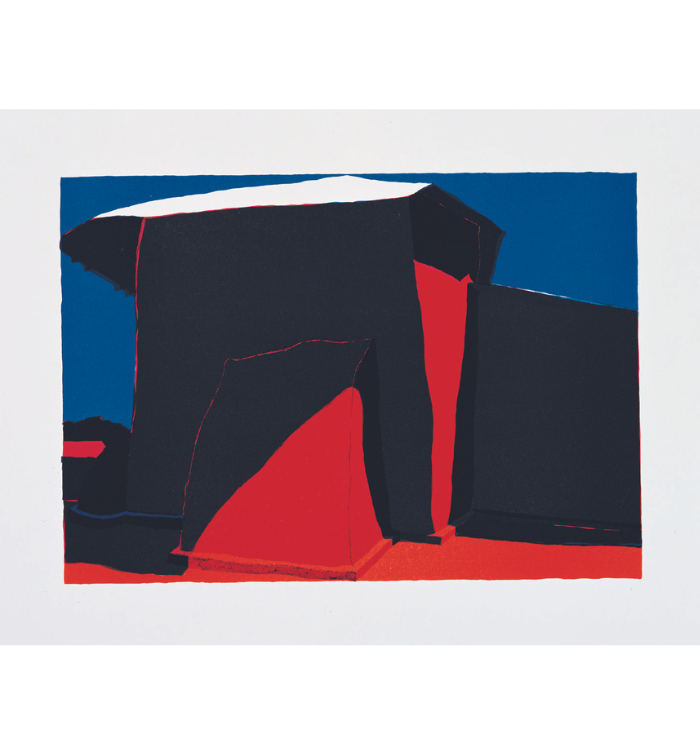
1996 H. Joe Waldrum "September 26-29, 1996"
"September 26-29, 1996" Poster 22" x 28"
Harold Joe Waldrum (1934–2003) was an American artist best known for his vivid abstract studies of Northern New Mexico’s historic adobe churches. Initially using a Polaroid SX-70 as a tool for planning his paintings, he eventually produced thousands of photographs that became an acclaimed body of work on their own, shown in multiple museums and galleries.
Before becoming a full-time artist, Waldrum taught music and art in Kansas for more than 15 years after graduating from Western State College. He completed a graduate degree in 1970 and soon relocated to New Mexico, which became the center of his artistic focus.
Later in his career, Waldrum worked to protect the very churches that inspired him. In 1985, he founded an organization dedicated to their preservation and created documentaries highlighting their decline and destruction. During the 1980s and 1990s, he also collaborated with printmakers to produce aquatint etchings and linocuts that echoed the style of his paintings.
Waldrum passed away in 2003 and is buried in Columbus, New Mexico. His work is included in the collections of several institutions, including the Museum of New Mexico, the Palm Springs Art Museum, the Albuquerque Museum, and the Harwood Foundation of Taos.